Today’s shoppers don’t think in channels. They think in convenience. A customer might browse a product on their phone during a commute, add it to a cart on a laptop that evening, and expect to pick it up in-store the next afternoon — or have it shipped to their door within days. To meet these expectations, retailers are dismantling channel-specific supply chains and moving toward true omnichannel fulfillment. This shift is no longer optional; it is quickly becoming the baseline expectation for anyone who wants to stay competitive in retail.
According to Boston Retail Partners’ (BRP) 2019 POS/Customer Engagement Survey, roughly 48% of retailers have already implemented a single commerce platform, and another 46% plan to have one in place within three years. In other words, within a few short years, nearly all serious retailers will be running unified, omnichannel-ready operations. Retailers who delay this transition risk falling behind on customer experience, inventory accuracy, and ultimately, revenue. (Source: Retail Dive, “Charting a Course to Omnichannel Fulfillment”)
Why Channel-Specific Supply Chains Are Breaking Down
For years, retailers ran separate systems for e-commerce, brick-and-mortar stores, and call centers. Each channel had its own inventory, its own checkout process, and often its own customer database. This worked reasonably well when customers stayed within a single channel — but that behavior has all but disappeared.
Modern shoppers move fluidly between channels. They expect “buy online, pick up in store,” ship-from-store, endless-aisle ordering, and seamless returns regardless of where a purchase was originally made. Supporting this kind of flexibility requires more than a patchwork of disconnected systems — it requires a single source of truth for inventory, orders, and customer data. This is exactly the gap that a modern retail point-of-sale system built on a unified commerce platform is designed to close.
The Rise of Unified Commerce Platforms
A unified commerce platform connects every customer touchpoint — web store, mobile app, physical register, marketplace listings, and customer service — into one connected system. Instead of syncing data between separate platforms after the fact, everything runs on shared infrastructure in real time.
This is where a well-integrated Cloud Based POS System becomes the backbone of retail operations. Rather than treating the point of sale as an isolated cash register, a Cloud-based Retail POS ties directly into the retailer’s ERP, e-commerce platform, and customer relationship data. When a sale happens on the shop floor, inventory updates instantly across every channel. When an online order comes in, store associates can see it, fulfill it, or answer questions about it without switching systems. Increasingly, retailers are also pairing this with an Online POS System for Retail, so web orders and in-store transactions run through the same real-time engine.
TCS POS for NetSuite: Built for Omnichannel Retail
For retailers running NetSuite as their ERP, TCS POS for NetSuite is purpose-built to extend that omnichannel promise all the way to the point of sale. Because TCS POS Software is natively integrated with NetSuite, there is no middleware translation layer, no nightly batch sync, and no risk of inventory drifting out of sync between the storefront and the stockroom.
Some of the core Benefits of TCS POS for NetSuite include real-time inventory visibility across every location and channel, a single customer record that follows shoppers from web to store, and consolidated reporting that gives management one accurate picture of performance instead of several conflicting ones. Because pricing, promotions, and product data live in NetSuite and flow directly to the register, staff never have to manually reconcile catalogs between systems.
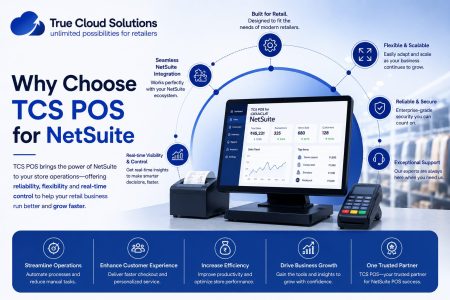
Why Choose TCS POS for NetSuite
There is no shortage of point-of-sale vendors on the market, so the question retailers naturally ask is: Why choose TCS POS for NetSuite over a generic, bolt-on POS product? The answer comes down to depth of integration and purpose-built design. Generic POS systems are retrofitted to “connect” to NetSuite through connectors that sync periodically, which introduces lag, errors, and blind spots in inventory. TCS POS is engineered from the ground up as TCS POS Integrations with NetSuite, meaning transactions, customer records, and inventory counts are reflected immediately, not eventually.
This tight coupling also simplifies TCS Netsuite Customisation, since retailers can tailor workflows, receipts, loyalty rules, and reporting directly within the NetSuite environment they already know, rather than learning and maintaining a separate administrative system.
Cloud POS Features for NetSuite That Matter Most
When evaluating any POS investment, retailers should look past the marketing language and focus on functionality that actually supports omnichannel operations. The most valuable Cloud POS features for NetSuite include:
- Real-time, two-way inventory sync across web, mobile, and physical stores
- Unified Product & customer management POS tools that keep catalog data, pricing, and customer profiles consistent everywhere
- Offline resilience, so registers keep working even during connectivity gaps
- Built-in support for buy-online-pickup-in-store and ship-from-store workflows
- Integrated payment processing and Cloud POS Billing Software functionality for faster, more accurate checkout
- Native reporting dashboards that pull straight from NetSuite, eliminating duplicate data entry
NetSuite POS Advantages for Growing Retailers
The NetSuite POS advantages become especially clear as a retail business scales. A single independent boutique can often get by with a standalone register. But once a business opens a second location, launches an online store, or starts fulfilling orders from multiple warehouses, disconnected systems quickly become a liability. Manual reconciliation eats staff time, and out-of-sync inventory leads to overselling, cancelled orders, and frustrated customers.
The NetSuite POS benefits for retailers go beyond convenience — they directly protect revenue. Accurate, real-time inventory reduces stockouts and overselling. A unified customer record enables more personalized marketing and loyalty programs. And centralized reporting gives leadership the visibility needed to make faster, better-informed merchandising and staffing decisions.
A Real-World Example: Bike Shops and Specialty Retail
Specialty retailers illustrate the omnichannel challenge particularly well. Take a Bike store point of sale system as an example. Bike shops typically carry high-value inventory with many size, color, and component variations, alongside services like repairs, fittings, and custom builds. A generic register cannot easily manage serialized inventory, service scheduling, and loyalty tracking together.
This is where NetSuite POS for bike shops and similarly purpose-fit solutions make a measurable difference. A well-configured POS solutions for bike retailers setup, or more broadly a Retail POS for bike stores configuration, allows staff to look up whether a specific frame size is available at another location, schedule a repair, and check a customer’s purchase history — all from the same screen, all fed by the same NetSuite database. Purpose-built Bike shop POS software also handles service tickets and warranty tracking that generic registers simply weren’t designed for. The same logic applies across specialty categories, from outdoor gear to electronics to apparel, wherever variant-heavy, service-driven Retail shop software is required.
Beyond the Register: Freight, Logistics, and Fulfillment
Omnichannel fulfillment isn’t only about what happens at checkout — it’s also about how orders move afterward. Retailers shipping from multiple locations need accurate, real-time freight data to quote shipping costs correctly and get orders out the door on time. Solutions like a Smart Freight Connector for NetSuite or a broader Smart Freight NetSuite connector integration extend the same real-time philosophy from the point of sale into the shipping dock, giving retailers a single connected view from order to delivery. Paired with a NetSuite freight integration solution, retailers can automate carrier selection and rate shopping without leaving their core ERP environment.
Choosing the Right Retail POS System Features
Not every business needs every feature on day one, but it pays to choose a platform built to grow with the business. Look for Retail POS system features such as flexible payment options, robust discounting and promotion rules, multi-location inventory visibility, and strong reporting. A platform offering broad POS Retail Solutions coverage — not just checkout, but inventory, customer engagement, and fulfillment — will save retailers from having to re-platform again in a few years.
Retailers evaluating vendors should also ask about total cost of ownership. Understanding TCS services pos price structures upfront, including implementation, training, and ongoing support, helps avoid budget surprises later and makes it easier to compare a truly native NetSuite integration against generic alternatives that appear cheaper but carry hidden integration costs.
Seeing It in Action
Reading about omnichannel capabilities is useful, but seeing the workflow in action makes the value concrete. Retailers researching a new system often start with TCS POS for NetSuite Videos or a broader Cloud POS Video Showcase, which walk through real checkout, inventory, and reporting workflows rather than relying on slide decks alone. Watching POS Demo Videos for NetSuite is often the fastest way for a retail operations team to evaluate whether a platform’s day-to-day workflow actually fits how their staff work, and existing customers can review the same material or manage their account through TCS POS Integrations login access.
The Bottom Line
Omnichannel fulfillment has moved from a competitive advantage to a baseline expectation. With nearly half of retailers already running a unified commerce platform — and almost all others planning to within a few years — the retailers who wait risk losing customers to competitors who can already deliver a seamless buy-anywhere, fulfill-anywhere experience.
A tightly integrated Cloud POS Systems strategy, especially one built natively for NetSuite, gives retailers of every size and specialty — from bike shops to multi-location chains — the real-time inventory accuracy, unified customer data, and streamlined fulfillment they need to meet modern shopper expectations and grow with confidence.
Frequently Asked Questions
1. What is omnichannel fulfillment?
Omnichannel fulfillment is the practice of allowing customers to shop through any channel — web, mobile, marketplace, or in-store — and receive their order through the method they prefer, such as home delivery, in-store pickup, or ship-from-store, all supported by one connected inventory and order system.
2. Why are retailers moving away from channel-specific supply chains?
Channel-specific supply chains create disconnected inventory, inconsistent pricing, and a fragmented customer experience. As shoppers move fluidly between online and offline channels, retailers need one connected system to keep inventory accurate and fulfillment fast.
3. How many retailers currently use a single commerce platform?
According to Boston Retail Partners’ 2019 POS/Customer Engagement Survey, roughly 48% of retailers had already implemented a single commerce platform, with another 46% planning to do so within three years.
4. What makes TCS POS for NetSuite different from other POS systems?
TCS POS for NetSuite is built as a native extension of NetSuite rather than a third-party system connected through periodic syncing. This means inventory, customer data, and transactions update in real time, without the lag or errors common with bolt-on integrations.
5. Can TCS POS support specialty retailers like bike shops?
Yes. NetSuite POS for bike shops and similar specialty retail configurations can manage serialized inventory, size and component variants, repair scheduling, and customer purchase history from a single connected screen.
6. What Cloud POS features for NetSuite should retailers prioritize?
Retailers should prioritize real-time inventory sync, unified product and customer management, offline resilience, buy-online-pickup-in-store support, integrated payment processing, and native reporting that pulls directly from NetSuite.
7. Does a cloud-based POS system work without an internet connection?
A well-built cloud based POS system typically includes offline resilience, allowing registers to keep processing sales during connectivity interruptions and automatically syncing data once the connection is restored.
8. How does POS integration affect shipping and freight management?
Tools such as a SmartFreight Connector for NetSuite extend real-time data from the point of sale into logistics, allowing retailers to automate carrier selection, rate shopping, and order tracking from within their existing NetSuite environment.
9. How can retailers evaluate a POS system before committing?
Many vendors offer POS Demo Videos for NetSuite or a broader Cloud POS Video Showcase so retail teams can see real checkout, inventory, and reporting workflows before making a purchase decision.
10. What should retailers ask about pricing before choosing a POS vendor?
Retailers should request a clear breakdown of TCS services pos price components, including implementation, training, and ongoing support, so they can accurately compare the total cost of ownership against other retail POS solutions.