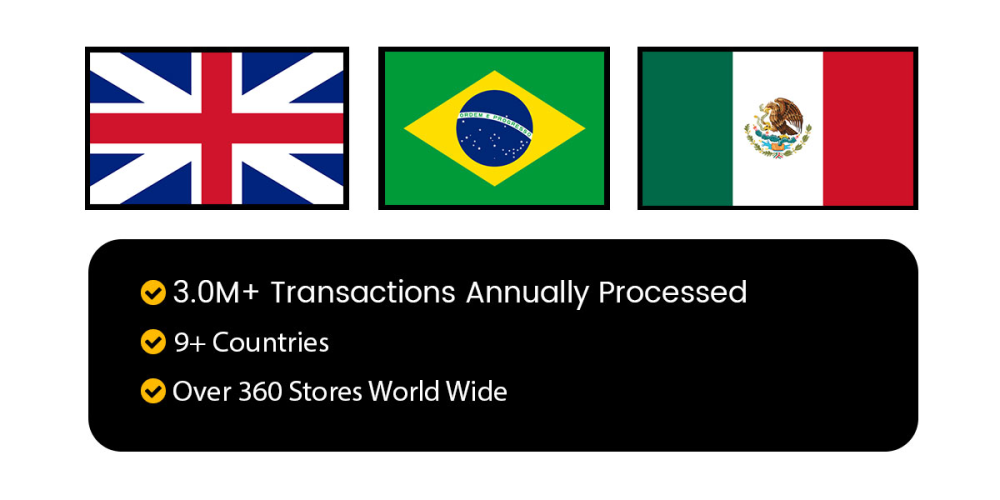
Growth milestones tell a story that marketing copy alone cannot. One of the clearest examples right now comes from a retail client running TCS POS for NetSuite, which has now grown past 50 stores and is on track to pass 100 stores by the end of this year. The same client is already operating across 9 countries, including the UK, with Mexico and Brazil set to come online shortly.
Numbers like these are worth paying attention to, not because big is automatically better, but because of what they reveal about what happens when a retail business scales quickly across borders. Adding new stores is one challenge. Adding new countries, currencies, tax rules, and languages on top of that is a different challenge altogether. A retailer cannot grow this fast without a point of sale setup built to keep up.
From a Handful of Stores to a Global Retail Network
Most retail businesses start small. A single store, a manageable amount of stock, and a point of sale system that just needs to ring up sales and keep count of inventory. That setup works fine until growth kicks in. Once a business moves from one location to ten, then from ten to fifty, the demands on its systems change completely.
Multi store retailers need stock visibility across every location, consistent pricing and promotions, centralised reporting, and the ability to onboard new stores quickly without rebuilding processes from scratch each time. Add international expansion into the mix, and a retailer also needs to handle multiple currencies, local tax requirements, and regional compliance rules without slowing down day to day operations.
This is exactly the kind of environment where a properly built NetSuite POS system proves its value. Rather than treating each new store or country as a separate project, a retailer running on a connected platform can bring new locations online using the same core setup, with only the local details adjusted.
Why Fast Growing Retailers Choose TCS POS for NetSuite
There are a few reasons a retailer scaling into double digit countries would choose this kind of setup over a patchwork of regional systems.
One source of truth. Every store, in every country, feeds sales, stock, and customer data back into the same NetSuite environment. There is no need to reconcile numbers between disconnected systems at the end of each month.
Faster store rollouts. New stores can be added to an existing framework instead of starting from zero, which matters a great deal when the plan is to nearly double store count within a single year.
Consistent customer experience. Whether a shopper is in the UK or a future store in Mexico, staff work from the same tools, the same processes, and the same access to product and customer information.
Built to grow with the business. A retailer confident enough to expand into new markets needs software that will not become a bottleneck the moment growth accelerates.
Retailers wanting to understand why this approach works so well for scaling businesses can read more in this breakdown of why retailers are choosing TCS POS for NetSuite integration.
What International Expansion Actually Demands From a POS System
Opening a store in a new country is rarely as simple as opening another store in the same market. Currency handling, local payment methods, tax rules, and even basic things like receipt formatting can all differ from one country to the next.
This is where the Benefits of TCS POS for NetSuite become clear for a retailer moving into new territory. A platform built to work natively with NetSuite carries financial, tax, and inventory logic through to every new location, rather than requiring a separate configuration built from scratch for each country. The NetSuite POS advantages become most obvious at exactly this stage of a retailer’s growth, when the cost of getting it wrong multiplies with every new market.
It also explains why choose TCS POS for NetSuite over building a custom solution in house. Retailers expanding at this pace do not have the luxury of spending months developing bespoke software for every new region. They need a system already proven to handle multi country, multi currency retail operations.
Customisation That Keeps Pace With a Growing Business
No two retailers operate identically, and a business running stores across 9 countries almost certainly has requirements that differ from a single country operator. This is where TCS Netsuite Customisation plays a role, allowing the core platform to be shaped around specific workflows, reporting needs, or regional requirements without losing the benefits of a single connected system.
Retailers considering a similar path often start by reviewing TCS POS Software and mapping out which parts of their operation need standard functionality and which parts need tailoring. Getting this balance right early on tends to make later expansion far smoother, since the foundation is already built to flex rather than needing to be reworked every time a new market is added.
Integrations That Keep Everything Connected
A retailer running dozens of stores across multiple countries depends heavily on how well its systems talk to each other. This is where NetSuite POS Integration becomes central to daily operations, connecting the point of sale layer directly with inventory, financials, and customer records inside NetSuite.
Strong TCS POS Integrations mean a sale made in a UK store updates stock levels, financial records, and customer history in real time, without manual intervention. As the client behind this growth story adds stores in Mexico and Brazil, this same integration layer is what will allow those new locations to plug into the existing system rather than operating as isolated outposts.
For retailers weighing up how deeply their point of sale should be woven into their ERP, it is worth understanding the POS integration options available, since the choice between a native setup and a connector based approach can significantly affect how easily a business scales later on.
What Comes Next: Mexico and Brazil
Expansion into Mexico and Brazil represents a new stage for this retail client, moving further into Latin America after already establishing a presence across Europe and other regions. Each new country brings its own regulatory and operational requirements, but the underlying approach stays the same: extend the existing NetSuite POS environment rather than starting over.
Retailers watching this kind of growth often ask what practical steps make it possible. It comes down to a system that was built with scale in mind from the beginning, a customisation approach flexible enough to handle regional differences, and integrations solid enough that adding a new country does not mean adding a new set of problems.
Retailers earlier in their growth journey who want to see how this looks in day to day operations may find it useful to read how to improve customer experience with a smarter NetSuite retail POS setup, which covers many of the same principles at a smaller scale.
Final Thoughts
Passing 50 stores, heading toward 100, and operating across 9 countries with more on the way is a meaningful milestone for any retailer. It is also a strong signal of what a well built NetSuite POS setup can support when a business commits to scaling quickly. For retailers with similar ambitions, the lesson is straightforward: the systems put in place at 5 or 10 stores need to be capable of supporting 50 or 100, in one country or several, without requiring a rebuild every time the business grows.
Frequently Asked Questions
1. What does it mean for a retailer to run TCS POS for NetSuite across 50 or more stores?
It means every one of those stores shares the same connected system for sales, stock, and customer data inside NetSuite, rather than each location running on separate or disconnected software.
2. Why is international expansion harder for a POS system than simply adding more local stores?
New countries bring different currencies, tax rules, payment methods, and compliance requirements, all of which a POS system needs to handle correctly without disrupting daily operations.
3. How does a NetSuite POS system support fast growing multi store retailers?
It gives a business one connected source of data across every location, which allows new stores to be added using an existing framework instead of building separate processes from scratch each time.
4. What role does customisation play in a retailer’s growth?
Customisation allows a core POS platform to be adjusted for specific workflows, reporting needs, or regional requirements, so the business does not have to compromise on how it actually operates as it grows.
5. Why do integrations matter so much for a retailer expanding into new countries?
Strong integrations mean sales, stock, and financial data update automatically across the whole business, which becomes essential once a retailer is managing stores across multiple countries and time zones.
6. What is the difference between a native POS integration and a connector based one?
A native integration is built directly into NetSuite’s core structure, while a connector links an external POS system to NetSuite. Each has trade offs in terms of flexibility, maintenance, and long term scalability.
7. Can a retailer add new countries without rebuilding its POS setup each time?
Yes, provided the underlying platform is built to scale. A well integrated NetSuite POS setup allows new stores and countries to be added to the existing framework rather than requiring a new build each time.
8. What should a growing retailer look for before expanding into a new country?
Key things to check include how the POS system handles local currency and tax rules, how quickly a new store can be onboarded, and whether existing customisations will carry over to the new market.
9. Why would a retailer choose TCS POS for NetSuite over a custom built solution?
A proven platform saves the time and cost of building and testing custom software for every new market, while still allowing enough customisation to fit specific business needs.
10. What can smaller retailers learn from a client scaling to 100 stores across 9 countries?
The main lesson is to choose systems early on that can grow with the business, since a POS setup that works well for a handful of stores will not automatically hold up once the business expands into new markets or countries.